Deep Sea Fishing In Turks And Caicos: What You'll Catch, What It Costs, And What To Expect
Two miles off Providenciales, along a stretch fishing captains call the Wall, the sea floor falls away from the shallow Caicos Bank into water that runs thousands of feet deep. That short run to real depth is the reason a four-hour charter here can produce species that usually take a full day offshore almost anywhere else in the Caribbean, and it changes what a realistic morning of fishing actually looks like once you're on the water.
Use the section recommendations to match an outing to your trip, then compare dates and trip details at the end.
This guide covers what you'll actually catch by season, what a private charter includes and doesn't, what it costs and why one boat can run well above the regional average, the license rules almost nobody explains clearly, and the questions first-time anglers tend to ask before they ever step onto the dock at Turtle Cove Marina.
For a Providenciales fishing morning, start with the private Angler Management charter from Turtle Cove, then compare a separate sailing or shared reef day if you want a different kind of boat outing.
Your Turks And Caicos Plan
- Choose the private Turtle Cove charter when offshore fishing is the main goal.
- Confirm license coverage, pickup terms, catch handling, and cancellation details before paying.
- Give fishing and reef snorkeling separate days when both matter.
What Fish Are You Actually Trying To Catch?
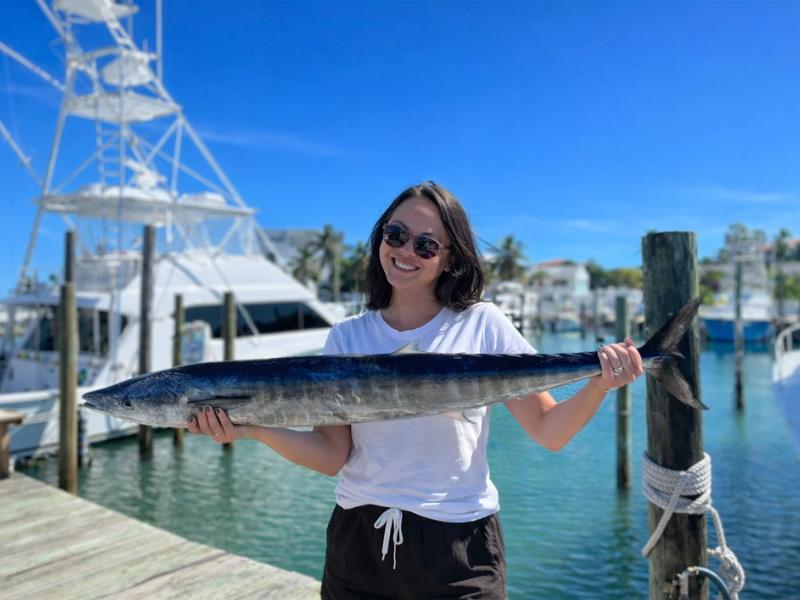
The species mix off Turks and Caicos shifts with the season more than most first-time anglers expect. Wahoo and mahi mahi, also called dolphinfish, are the winter headliners, running strongest from roughly November through April. Sailfish move through on a similar winter-to-spring window. Push into late spring and summer and the target list changes to blackfin and yellowfin tuna, with blue and white marlin showing up from May through August. A handful of species don't pay attention to the calendar at all: barracuda, skipjack, mackerel, horse-eye jack, and reef sharks turn up on the same trolling runs more or less year-round.
| Season | Primary Target Species | Notes |
|---|---|---|
| November to April | Wahoo, mahi mahi, sailfish | The strongest window for wahoo specifically; sailfish must be released |
| May to August | Blackfin and yellowfin tuna, blue and white marlin | All marlin species are catch-and-release only under TCI law |
| Year-round | Barracuda, skipjack, mackerel, horse-eye jack, reef sharks | Reliable backup action on slower days for the seasonal species; sharks must be released |
The private charter aboard Angler Management, based at Turtle Cove Marina on Providenciales, lists Mahi Mahi, Wahoo, and Barracuda specifically in its own description, which lines up with what the winter season actually produces on these grounds. Guests on similar boats working the same water have also landed yellowfin tuna and hooked into blue marlin, though the marlin, like every billfish species in TCI waters, goes back over the side no matter how hard it fought.
What Each Species Is Actually Like To Catch
Knowing the names on a target list doesn't tell you much about what the fight actually feels like, and the species here vary enormously in how they behave once hooked. Wahoo are the speed specialists: a hooked wahoo can strip line off a reel in a single blistering run before most anglers have even set their feet, and it's that first run, not the fish's size, that makes people remember the catch. Mahi mahi fight differently, more acrobatic than fast, often clearing the water in a series of jumps that show off the fish's electric blue and gold coloring before it tires.
Tuna are pure endurance. Blackfin tuna, the smaller and more common of the two here, still pull hard enough to tire out an angler's arms on a rod without a fighting harness, and yellowfin, which run larger, can turn a ten-minute fight into thirty. Marlin sit in a different category entirely: a blue marlin can weigh several hundred pounds, and even a modest one will test the boat's drag settings and the angler's stamina before the mate leaders it boatside for release. Barracuda, by contrast, are the fast, reliable action fish. They strike aggressively, don't require finesse to hook, and are common enough that a slow day for the bigger species rarely means a quiet day on the water.
Where The Fish Actually Live: A Quick Geography Primer
The Caicos Bank, the shallow shelf that Providenciales and the other Caicos Islands sit on, averages only a few meters deep across a huge stretch of water, which is part of why the shore snorkeling and calm sailing conditions this island is known for exist in the first place. That same shallow bank is exactly why a short run out matters so much for fishing. Along the north side of Providenciales, the bank's edge gives way to the open Atlantic, and depth increases from a few dozen feet to well over a thousand within a short distance of shore. Turtle Cove Marina, where this charter departs from, sits on that north side specifically because it puts boats close to that drop-off rather than requiring a long crossing of the shallow bank first.
Why The Short Ride Out Matters
Most Caribbean deep sea fishing requires a long run before the boat even starts trolling, sometimes an hour or more each way, which eats into the actual fishing time on anything shorter than a full-day charter. Providenciales doesn't have that problem in the same way. The edge of the Caicos Bank sits close enough to shore that a boat leaving Turtle Cove Marina can be trolling real depth within twenty to thirty minutes. On a four-hour charter, that difference is the whole trip: instead of two hours of transit bookending two hours of fishing, you get something closer to three and a half hours with lines actually in the water.
That's also the case for booking a shorter charter here instead of automatically upgrading to a full day. If the boat reaches productive water within half an hour, a four-hour trip isn't a compromise version of an eight-hour one. It's closer to a full session with less dead time on either end.
What A Private Charter Actually Includes (and What It Doesn't)
Charter inclusions vary by operator, and it's worth checking the fine print before comparing prices. A cheap quote that excludes tackle or charges a per-pound fish-cleaning fee at the dock can end up costing more than a higher quote that already includes everything. The Angler Management charter, a 48-foot Ocean Super Sport sportfishing yacht taking up to 10 guests, includes the pieces that matter most for a first-time or infrequent angler.
| Typically Included | Typically Not Included |
|---|---|
| Professional captain and mate | Ground transportation to the marina |
| Fishing tackle and bait | Full meal service (light snacks and an open bar of beer, soda, and water are provided) |
| Cleaning and filleting of your catch | Gratuities for the captain and mate |
| Snorkeling equipment for downtime between bites | Hard liquor or heavier spirits |
| Fishing license, arranged by the operator | International travel insurance |
The cleaning and filleting line matters more than it looks on paper. A lot of first-time charter guests don't realize that "you keep what you catch" can sometimes mean you keep it whole, blood, scales, and all, unless the crew processes it for you. Having the crew clean and fillet the catch dockside, which is standard on this charter, is the difference between walking off the boat with dinner and walking off with a project.
What A Morning Aboard Actually Looks Like
Charters departing Turtle Cove Marina typically leave around 8:00 AM, after a short safety briefing on deck covers where gear is stowed and how the boat handles a hooked fish running for the horizon. The transit to productive water takes roughly 20 minutes given how close the drop-off sits to shore, which means lines are usually in the water well before 8:30. The middle stretch of the trip is a mix of active trolling and genuine downtime: snacks and drinks are available throughout, and on slower stretches between strikes, some guests use the provided snorkeling gear to look around near the boat rather than just waiting on a bite. The trip winds down with a return to the marina around midday, followed by the crew cleaning and filleting whatever's legal to keep, so you're walking off the dock with fillets in hand by early afternoon, well ahead of most people's lunch plans.
Shared Vs Private: Do You Have To Book The Whole Boat?
Not every fishing trip in Turks and Caicos requires chartering an entire sportfishing yacht. The island also offers shared reef and bottom fishing charters, where individual seats are sold rather than the whole boat, aimed at travelers who want to fish without the cost of a private big-game charter. These trips typically target different water than a deep sea charter, closer to the reef rather than the offshore drop-off, and the species list leans toward snapper, grouper, and other bottom fish rather than wahoo, tuna, or marlin. For a solo traveler or a couple who wants the experience of catching something without the price tag of a private yacht, asking a local operator about a shared trip is worth doing before defaulting to a full private charter built for up to 10 guests.
Booking A Charter: What To Ask Before You Reserve
A few questions upfront prevent surprises on the dock. Confirm whether the fishing license is included in the quoted price, since it almost always is on a reputable operator's listing, but it's worth hearing it stated plainly rather than assuming. Ask what the weather cancellation policy looks like, since offshore trips are more sensitive to wind and swell than a sheltered snorkeling tour, and a good operator will have a clear rebooking or refund process rather than a vague "we'll see how it looks that morning" answer. If you're traveling with children, ask whether the boat has shade beyond a bimini top and whether smaller life jackets are available, since a 4-hour trip in direct sun is a different experience for a eight-year-old than for an adult who chose to be there.
It's also worth asking directly what happens to a catch beyond what your group can eat. A crew that offers to arrange a "cook your catch" meal at a local restaurant, common practice on this island for guests who don't have kitchen access at their hotel, is worth knowing about before you're standing on the dock with a cooler of fresh mahi mahi and no way to cook it. Finally, confirm the group size the price is based on. A charter quoted as a flat rate for up to 10 guests works very differently, financially, for two anglers than it does for a full group, and it's worth deciding before you book whether you're filling those seats or paying the couple's-rate premium covered earlier in this guide.
Where This Fits Into A Longer Trip
A morning charter pairs naturally with an itinerary that treats it as one dedicated half-day rather than an add-on squeezed between other plans. Because most charters run about 4 hours and start early to catch the best feeding window, the rest of that day is realistically an afternoon of rest, cleaning up, and enjoying the catch, not a second excursion. Travelers planning a longer stay who want both a reef-focused boat day and a dedicated fishing morning are better served by a 5- to 7-day trip that gives each its own day, rather than trying to compress both experiences into a shorter visit where one of them ends up feeling rushed.
What Does Deep Sea Fishing Actually Cost In Turks And Caicos?
Private charters here run more expensive than the Caribbean average, and there's a real reason beyond simple markup. Across the wider Caribbean, charter booking marketplaces put the average half-day private trip at roughly $1,126 and a full day at around $2,023, with the overall range spreading from about $449 at the low end to $3,400 or more for premium boats. In Turks and Caicos specifically, private sportfishing charters commonly start around $1,600 to $1,900 for a half day and climb to $3,500 to $4,500 for a full eight-hour trip, before the mandatory 12% government tourism tax.
That puts a $3,151 four-hour charter at the upper end of what a half-day trip typically costs on this island, and the premium tracks with what you're actually booking: a dedicated 48-foot sportfishing yacht, a professional crew, and capacity for up to 10 people, rather than a smaller center-console boat built for two or four anglers. The per-person math changes the picture considerably once a group fills more of those seats.
| Group Size | Cost Per Person (before tax) |
|---|---|
| 2 guests | $1,575.50 |
| 4 guests | $787.75 |
| 6 guests | $525.17 |
| 8 guests | $393.88 |
| 10 guests | $315.10 |
A couple splitting this charter is paying a genuine luxury-experience rate. A group of eight or ten, whether that's a bachelor trip or an extended family gathering, is paying close to what a shared half-day snorkeling tour costs per person elsewhere on the island, but for a private big-game boat with a crew focused entirely on their group. If cost is the deciding factor and your group is smaller than six, it's worth asking operators directly whether a shared or semi-private trip is available.
The broader reason island prices sit above what a lot of visitors expect isn't specific to fishing. Turks and Caicos imports nearly everything, including fuel, and the government tourism tax adds 12% on top of most quoted activity prices before gratuity is even factored in. A sportfishing yacht burns a meaningful amount of fuel on every trip, crew wages reflect a small-island labor market, and none of that shows up as a discount just because the boat happens to be back at the dock by noon. Framed against that backdrop, the premium this charter carries over a generic Caribbean average looks less like an outlier and more like what running a serious sportfishing operation actually costs on this particular island.
Do You Need A Fishing License?
Yes, technically. Turks and Caicos requires a permit from the Department of Environment and Coastal Resources for anyone fishing in its waters, and the rule is applied broadly enough that even a non-fishing passenger aboard a boat carrying tackle can be expected to hold one. A single-day permit runs around $10 to $15 depending on where it's purchased, and a 30-day permit runs $30 to $35.
In practice, this almost never becomes the traveler's problem. Charter operators, including the one running this trip, buy the licenses for their guests as part of the booking and fold the cost into the quoted price. If you're planning to fish independently, from a rented boat or from the shore, that's the scenario where you need to sort out the permit yourself before you cast a line. Fishing without one carries a penalty that most visitors never test: TCI law allows a fine up to $50,000 and up to 12 months imprisonment for unlicensed fishing, which is a steep price for skipping a $10 permit.
What You Can Keep, And What Has To Go Back
Not everything that bites is yours to take home. Turks and Caicos law protects billfish, blue marlin, white marlin, sailfish, and swordfish, as strict catch-and-release species, along with sharks. There are no exceptions, regardless of size or how good the photo would look on the dock. Wahoo, mahi mahi, tuna, and barracuda are all legal to keep, and those are the species this charter's own listing highlights as the realistic targets for a morning trip.
The catch-and-release rule is worth knowing before you go, so that a genuinely exciting fight (and a blue marlin will fight hard) doesn't end in disappointment when the mate releases the fish instead of gaffing it. It's also why serious sportfishing operators here tend to work with tag-and-release conservation programs rather than treating the law as an inconvenience to get around.
Tips For First-Time Anglers
You don't need experience to book this. The captain and mate handle bait, rigging, and boat positioning, and they coach first-timers through fighting a fish that's actually taken the line, which is a different skill than casting from a dock or a lake back home. When a rod bends hard, the instinct is usually to reel as fast as possible, but the mate will typically tell you to lean back and let the rod do the work first, reeling only as you come forward again. It's a rhythm that takes one or two fish to get comfortable with, and nobody expects you to have it down on the first strike.
Morning departures matter more here than the schedule suggests. Fish tend to feed more actively in the early hours, and charters leaving Turtle Cove Marina typically depart around 8:00 AM specifically to catch that window before the bite slows through the middle of the day. Being on the dock fifteen minutes early is a small thing that keeps the whole morning on schedule for everyone aboard, not just you.
Group dynamics matter more on a fishing charter than on most tours. With up to 10 guests aboard and typically two or three rods actively fishing at once, there's a rotation to who gets the rod when something strikes, and the mate usually manages that fairly rather than letting the same one or two people take every fish. If you're traveling with a group and someone in your party has never fought a fish before, it's worth telling the crew that upfront so they can make sure that person gets a fair shot at a bite rather than the more experienced anglers instinctively grabbing the rod first.
What To Pack For A Morning On The Water
A few practical choices make the four hours noticeably more comfortable. Non-spray, reef-friendly sunscreen holds up better on a moving boat than an aerosol, which the wind carries away before it lands on your skin, and a wide-brimmed hat or a cap with a neck flap covers the areas sunscreen tends to miss. Polarized sunglasses cut the glare off the water enough to actually see fish following a lure near the surface, which is as much a functional tool here as an accessory.
Motion sickness medication, taken the night before or at least an hour before departure, is worth carrying even for people who don't normally get seasick, since trolling involves a slower, different rocking motion than a fast reef-hopping snorkel tour. A light long-sleeve layer helps against both sun and the wind chill that builds up once the boat is moving at speed. Bring a way to carry your fillets home too, a small cooler or a heavy-duty insulated bag, since the crew hands you cleaned fish, not a system for transporting it back to your hotel kitchen or a restaurant willing to cook it for you. Cash for tipping the captain and mate at the end of the trip, in the range of 15 to 20% of the charter price, is worth having on hand rather than sorting out afterward.