Marine Life In Turks And Caicos
Turks and Caicos is home to one of the world’s richest marine ecosystems, where vibrant coral reefs, sea turtles, rays, dolphins, and migrating humpback whales thrive in protected waters.
Use the section recommendations to match an outing to your trip, then compare dates and trip details at the end.
Last updated: July 4, 2026
Turks and Caicos sits on the third-largest barrier reef in the world and supports over 250 fish species, 60 coral species, green and hawksbill sea turtles, spotted eagle rays, Caribbean reef sharks, nurse sharks, and Atlantic bottlenose dolphins. From January to April, humpback whales migrate through the islands. JoJo the dolphin, a wild bottlenose who has freely interacted with swimmers since the 1980s, is a National Treasure of TCI. The marine environment is protected by DECR and requires reef-safe sunscreen, no touching of wildlife, and no collection of any marine life inside national parks.
Choose a Providenciales reef outing that matches how you want to view marine life, and keep whale watching on a separate Grand Turk or Salt Cay plan.
Your Turks And Caicos Plan
- Use a four-hour Grace Bay snorkel for guided barrier-reef time with equipment, lunch and drinks included.
- Use the 75-minute clear boat when you want reef viewing without entering the water.
- Arrange humpback watching on Grand Turk or Salt Cay because none of these Providenciales trips is a whale charter.
| Sea Turtles | Green and hawksbill; very common year-round | Shore snorkeling, boat tours, kayaking mangroves |
| Sharks | Nurse sharks, Caribbean reef sharks; common; harmless | Boat tours, scuba diving at outer reef sites |
| Rays | Spotted eagle rays and southern stingrays; regular sightings | Smith’s Reef, French Cay, boat snorkeling tours |
| Reef Fish | 250+ species; parrotfish, angelfish, grouper, barracuda | Any reef; shore or boat access |
| Dolphins | Bottlenose dolphins including JoJo (National Treasure) | Boat tours; often seen near Grace Bay |
| Humpback Whales | Seasonal: January through April | Salt Cay, Grand Turk, dedicated whale tours |
| Coral Species | 60+ species; sea fans, elkhorn, brain, staghorn coral | Any reef; outer barrier reef most impressive |
| Invertebrates | Queen conch, Caribbean spiny lobster, moray eels, shrimp | Reef crevices, seagrass beds, mangrove channels |
Source: Turks and Caicos Reef Fund, DECR, visittci.com. Verified June 29, 2026.
What Marine Life Can You See In Turks And Caicos?
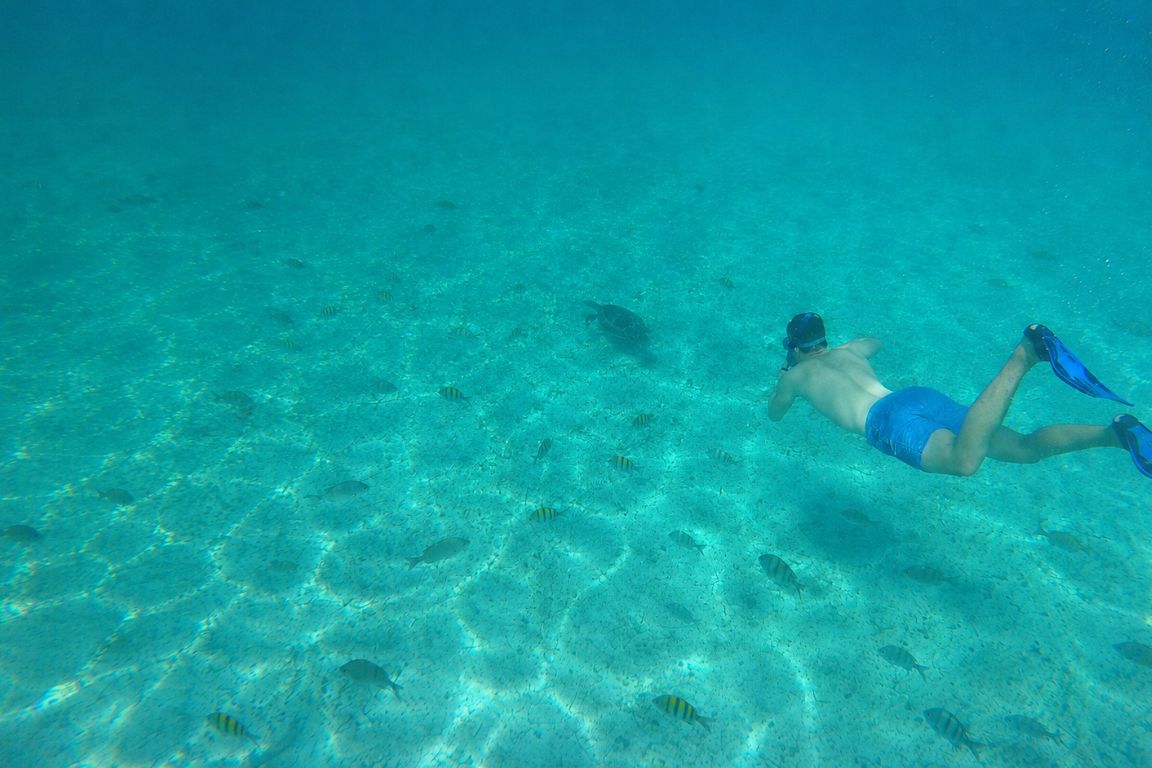 Turks and Caicos is home to one of the healthiest barrier reef systems in the Atlantic, the third-largest in the world. Visitors can expect to see green and hawksbill sea turtles, spotted eagle rays, southern stingrays, nurse sharks, Caribbean reef sharks, over 250 reef fish species, Atlantic bottlenose dolphins, and from January to April, migrating humpback whales. The reef supports 60-plus coral species and serves as the foundation for the entire marine ecosystem.
The Caicos Bank covers nearly 1,700 square miles with an average water depth of less than 20 feet, and the barrier reef that edges it is the second-largest in the Western Hemisphere. That geography produces something unusual: the wall, where the shallow bank drops abruptly to 7,000 feet of open ocean, sits just minutes from the beach by boat. This means snorkelers and divers access pelagic encounters, the large open-ocean species, at sites that would require deep offshore travel in most other Caribbean destinations. The water color that defines TCI aesthetically is a product of this same limestone shelf: sunlight bouncing off the pale seafloor at shallow depth creates the turquoise that photographers keep trying to accurately capture and consistently fail at.
The protected area network managed by the DECR covers much of the coastline around Providenciales and the outer cays. Princess Alexandra National Park, the Northwest Point and West Caicos Marine National Parks, and the Princess Alexandra Nature Reserve all enforce no-fishing, no-collection rules that directly sustain the marine life density visitors come to see.
We’ve got a full breakdown on whether Turks and Caicos is worth visiting if you want a straight answer on beaches, crowds, costs, and what makes it different from other Caribbean stops.
What Sea Turtles Live In Turks And Caicos?
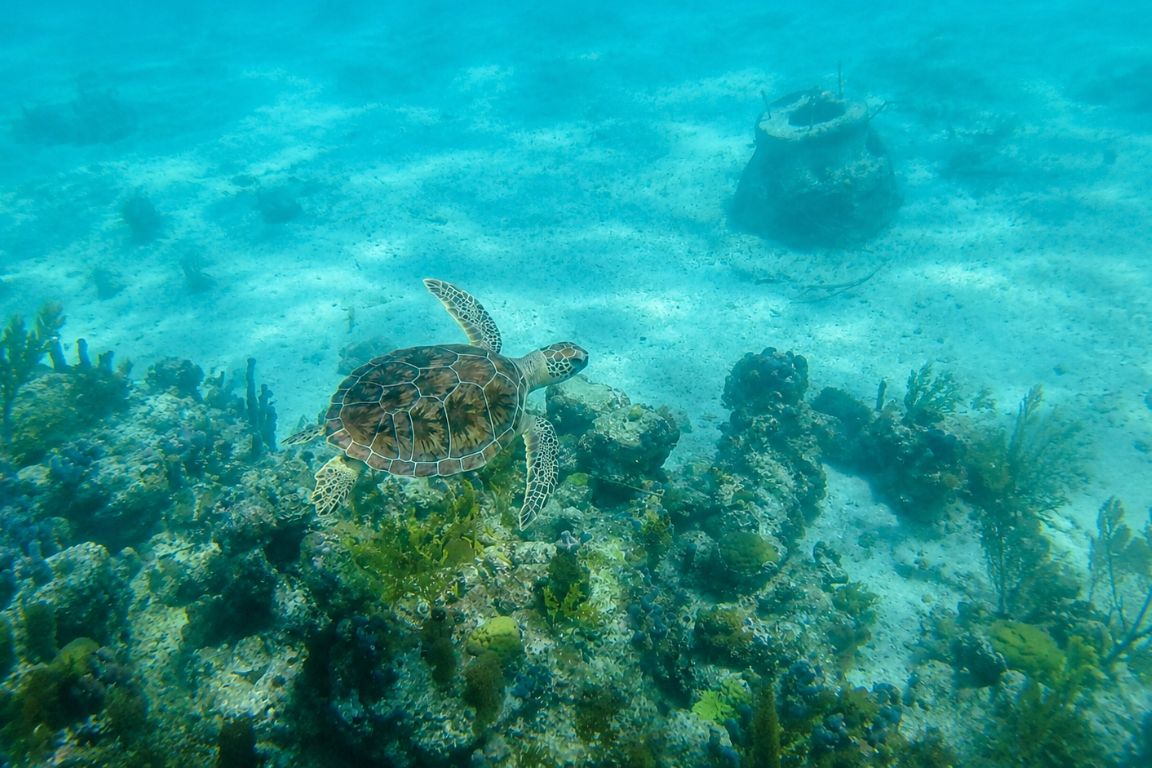 Two species are common in TCI: the green turtle and the critically endangered hawksbill. Green turtles are the most frequently encountered, often grazing on seagrass beds at Smith’s Reef and the Bight Reef directly off the beach. Hawksbill turtles are more commonly seen on the coral reef and wall dive sites. Loggerhead and leatherback turtles occasionally pass through but are rare. All sea turtles in TCI are wild.
A green turtle at Smith’s Reef doesn’t dart away when a snorkeler approaches. It tends to keep grazing, pulling algae from the seagrass with a steady rhythm, occasionally looking up, then returning to what it was doing. They can weigh up to 350 pounds and live 70 years or more. The ones in TCI’s protected waters have had enough seasons without harassment that they’ve developed what amounts to a working tolerance of people. It makes for snorkeling encounters that feel very different from destinations where marine life is actively avoiding you.
Hawksbill turtles are smaller, with the distinctive narrow beak that gives them their name, and they feed on sponges in the coral reef crevices where green turtles don’t tend to go. They’re the turtle you’re more likely to see on a boat tour to the outer reef or a scuba dive at West Caicos. Both species nest on remote cays, primarily Big Sand Cay and some North Caicos beaches, from April through August. The TCI Turtle Project, a collaboration between DECR and the University of Exeter, monitors populations with satellite tagging and enforces regulations including bans on turtle product exports and protections on breeding adults.
The water here is the whole point and a good boat tour makes it even better. Here’s the best boat tours in Turks and Caicos so you don’t end up on a crowded catamaran when a better option was available.
What Sharks And Rays Will You Encounter In Turks And Caicos?
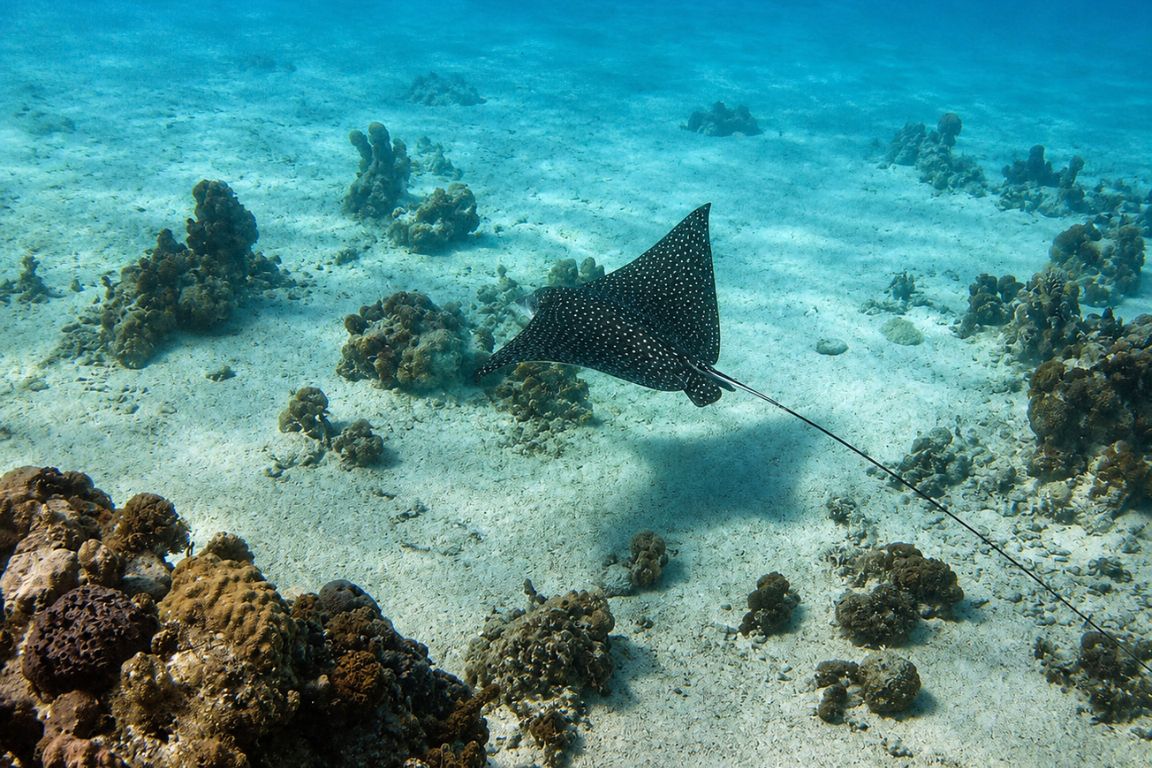 The most common sharks in TCI are nurse sharks and Caribbean reef sharks. Nurse sharks rest under coral ledges and in shallow sand channels; they are docile and commonly seen on reef tours. Caribbean reef sharks patrol the outer barrier reef and are more active. Spotted eagle rays and southern stingrays are regular sightings, with eagle rays particularly common at Smith’s Reef, French Cay, and along the outer reef wall. There are only three recorded shark attacks in TCI history, none fatal.
The nurse shark at a reef ledge is one of the defining sights of TCI diving. It lies still on the sand, up to ten feet long, apparently indifferent to the stream of snorkelers passing overhead. Nurse sharks feed on conch and crustaceans and have no interest in humans unless seriously provoked. French Cay has a large population at sites like G-Spot, where they rest in groups on the shallow reef top. Seeing several at once, bodies overlapping slightly in the sand, is one of those images that stays.
Caribbean reef sharks are more dramatic. They cruise the outer wall and the spur-and-groove reef formations, often several at once in good conditions at the West Caicos sites. They’re not aggressive toward snorkelers or divers in TCI, but they have the unhurried authority of an apex predator that doesn’t need to rush. Lemon sharks appear in the mangrove channels around Providenciales as juveniles, occasionally seen on kayak tours through Mangrove Cay. Tiger sharks and hammerheads exist in TCI waters but are rarely encountered by recreational visitors.
The spotted eagle ray earns its own mention. A nine-foot wingspan, white-spotted back, long trailing tail. They glide through the channel at Smith’s Reef and along the reef edge at French Cay with a slow, deliberate power that makes every sighting feel improbable. Some years, at the southern sites, they gather in schools. Watching fifteen or sixteen eagle rays moving together over the reef wall is an experience that stops conversation.
Trying to add something unique to your water itinerary? Here’s why clear kayak experiences in Providenciales deserve a spot on your TCI schedule.
What Fish Species Are Most Common On The Turks And Caicos Reef?
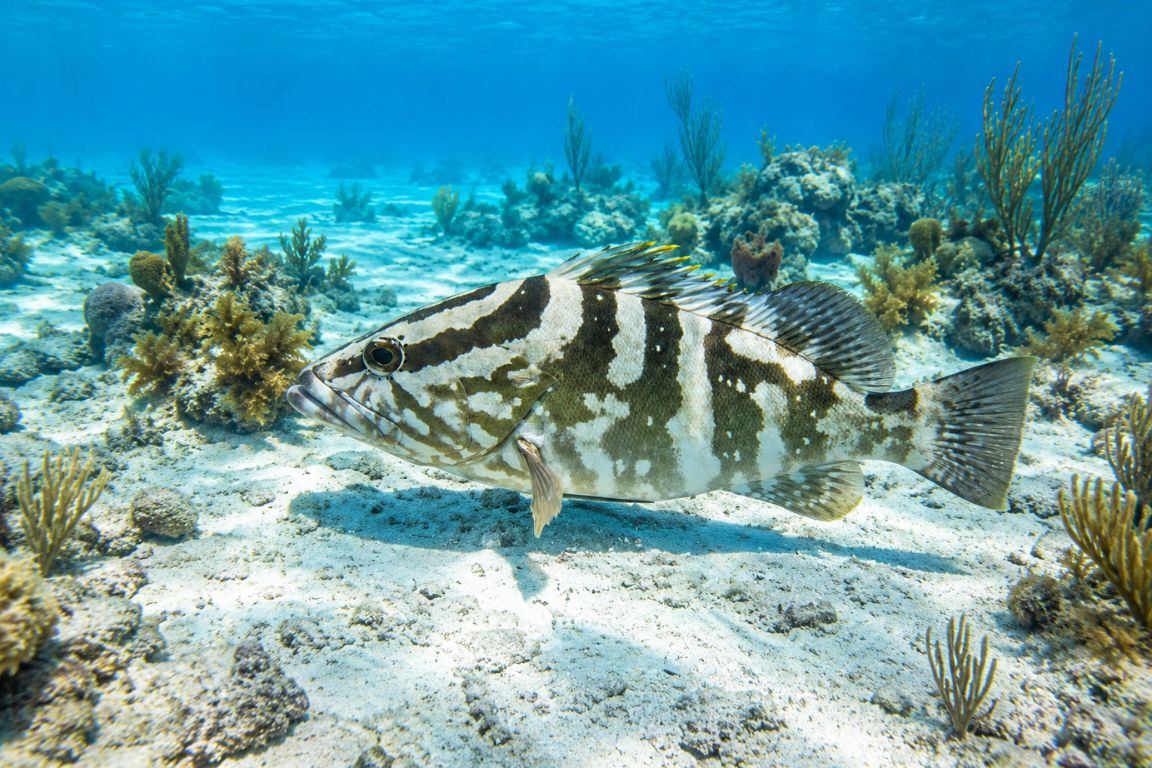 Over 250 fish species live on the TCI reef system. The most commonly encountered are stoplight parrotfish, queen angelfish, Nassau grouper, horse-eye jacks, yellowtail snapper, barracuda, trumpetfish, blue tang, French grunt, sergeant major, queen triggerfish, and squirrelfish. The barrier reef system particularly excels in parrotfish density and the diversity of reef fish overall.
Stoplight parrotfish are everywhere on the TCI reef. The males are vivid: bright green body, blue and pink face, orange edges on the scales. They bite chunks of coral with fused beak-like teeth to get at the algae inside, and the crunching sound is audible underwater. The white sand on TCI beaches is partly composed of parrotfish excrement: they digest the coral calcium and pass it as fine sand. A large parrotfish produces hundreds of pounds of sand per year.
Nassau grouper appear at cleaning stations on the barrier reef, hovering in place with pectoral fins spread while small wrasse remove parasites from their gills. Horse-eye jacks congregate at Northwest Point in hypnotic circling formations during safety stops, a cloud of silver reflecting light. Barracuda are ubiquitous and curious but not dangerous: they follow snorkelers at a distance, drawn by the same instinct that draws them to any large moving object. Remove sparkly jewelry before getting in the water.
The reef fish experience at the shore reefs near the beach is genuinely good. At the outer barrier reef it’s extraordinary: denser populations, larger individuals, more species per dive. A boat snorkeling tour to the outer reef shows a different order of fish life from the beach reefs, and experienced snorkelers who do both in the same trip consistently rate the outer reef as a different category of experience.
Can You See Humpback Whales And Dolphins In Turks And Caicos?
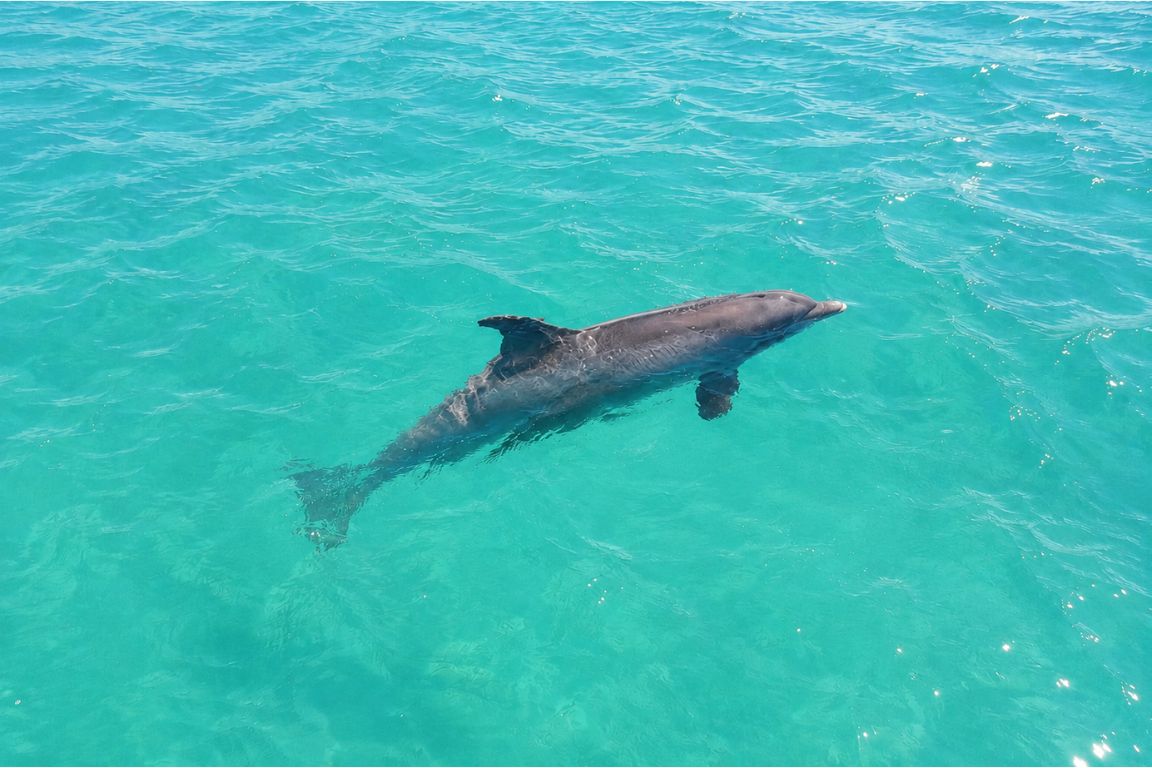 Humpback whales migrate through TCI waters from late December to early April, funneled through the Turks Island Passage near Salt Cay and Grand Turk. In-water encounters are possible on dedicated whale-watching tours. Atlantic bottlenose dolphins including JoJo, a wild dolphin declared a National Treasure by the TCI government in 1989, are seen year-round in Grace Bay and the Leeward area. Dreamer and Scooter, two other named dolphins, also frequently interact with boats and snorkelers.
JoJo has been swimming alongside humans in Grace Bay since the early 1980s. He is a wild Atlantic bottlenose dolphin, roughly 10 feet long and weighing around 880 pounds, who chose on his own terms to spend time with people rather than live exclusively with his pod. A wildlife advocate named Dean Bernal met him in 1981 and eventually relocated to TCI to document and protect him. In 1989, the government declared JoJo a National Treasure, the only time in TCI history a marine animal has received this designation. You cannot touch him; it’s illegal. You can swim alongside him if he chooses to approach, which he does, on his schedule and nobody else’s. His body carries propeller scars from years of navigating waters busy with boats. He keeps swimming anyway. There are people in TCI who have known JoJo for forty years.
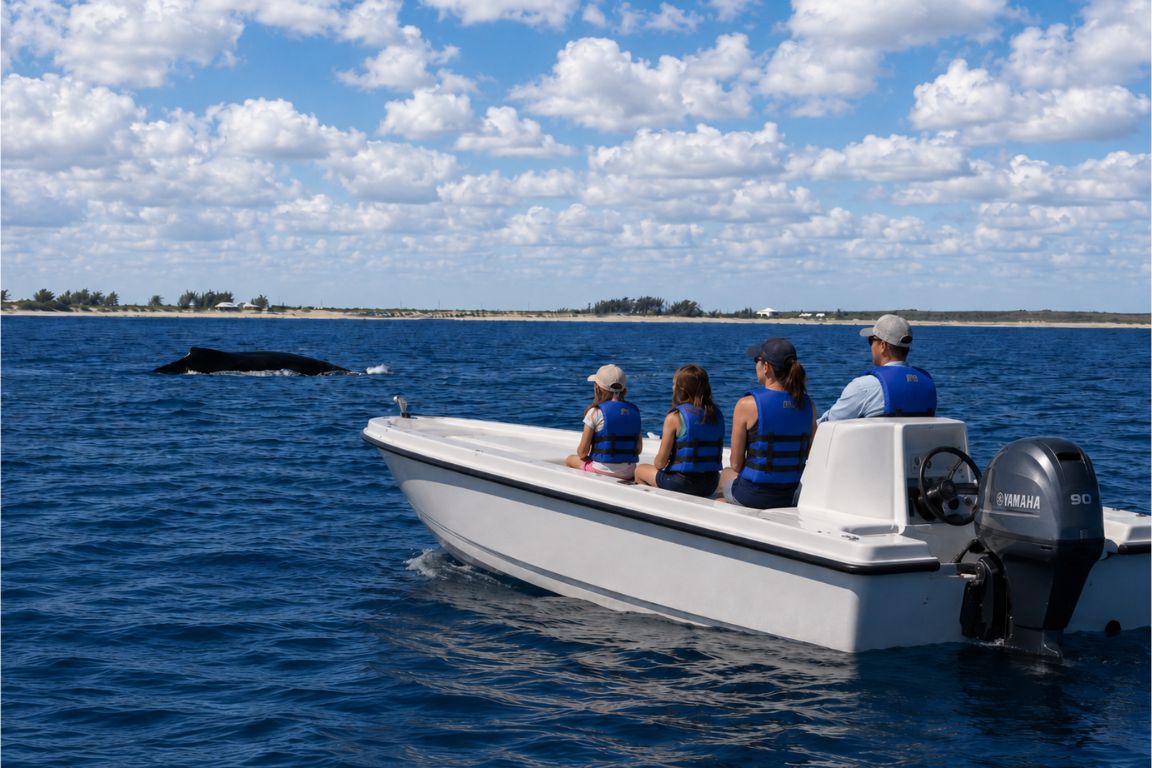
The humpback whale migration is something different entirely. These are animals that weigh up to 40 tons, and the ones passing through the Turks Island Passage between Grand Turk and Salt Cay are traveling between feeding grounds in the North Atlantic and birthing areas in warmer Caribbean waters. The water here is so shallow relative to the whales’ size that surface behaviors, breaching, lob-tailing, spy-hopping, are common sightings. On Big Blue Collective’s Edge of the Banks tours in January and February, in-water encounters sometimes happen: the captain stops the engine, guests slip quietly into the water, and a humpback whale passes within arm’s reach. No guarantee of it. When it happens, nobody who was there forgets it.
Humpbacks pass through TCI on one of the most predictable migration routes in the Atlantic. Here’s a full guide on the best time for whale watching in Turks and Caicos tours so you plan your trip around the right window.
What Invertebrates And Coral Species Live On The Reef?
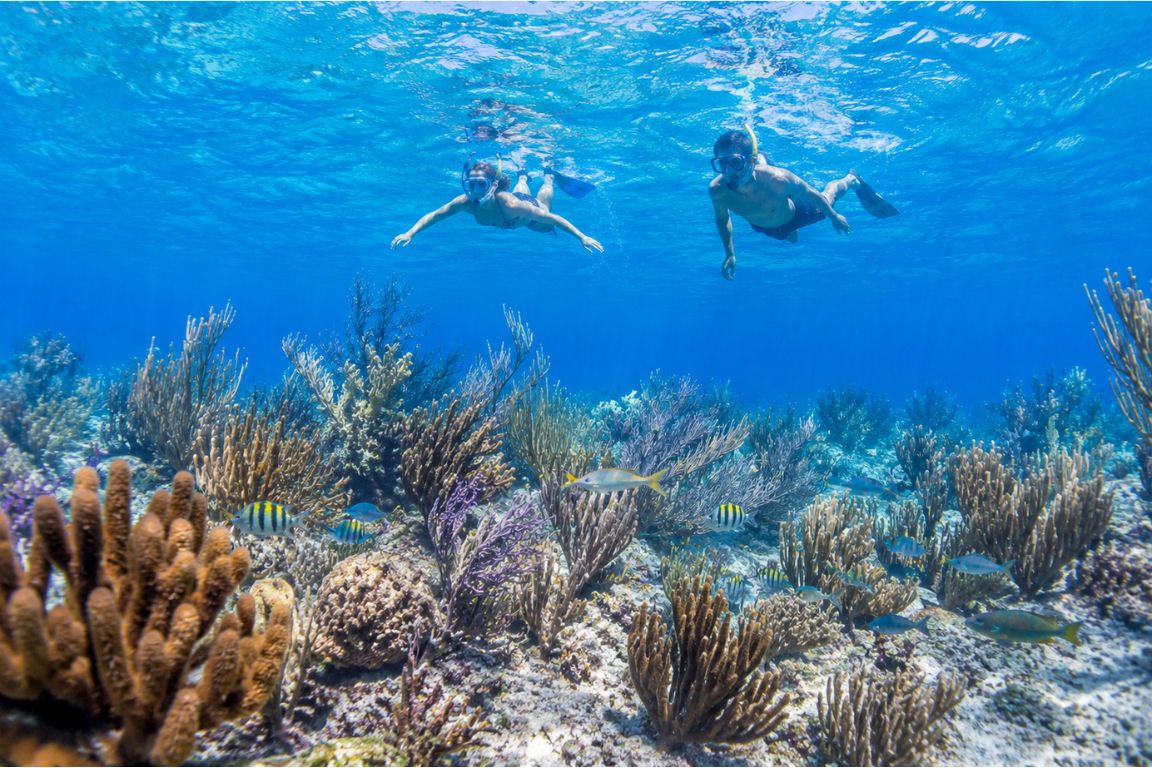
The TCI reef supports 60 coral species including sea fans, elkhorn, brain, staghorn, and massive barrel sponges at the outer reef sites. Key invertebrates include queen conch, Caribbean spiny lobster, banded coral shrimp, spotted moray eels, flamingo tongue sea snails, and Caribbean spiny lobster. The reef’s health is supported by the DECR’s no-fishing zones inside all national parks.
The sea fan beds at the outer barrier reef and West Caicos sites are visually remarkable: yellow and purple fans three and four feet across, swaying in the current, sheltering small fish and invertebrates in their branches. Elkhorn coral, which is critically threatened across most of the Caribbean, still exists in reasonable colonies at some TCI sites, a product of the protected area enforcement that limits boat anchoring, chemical runoff, and removal of any marine life.
Queen conch is the defining invertebrate of TCI culturally and ecologically. The giant marine snail grazes on seagrass, and the conch salad served everywhere on the island comes from these animals, harvested under DECR season controls. Inside national parks, collecting conch is illegal. Outside protected areas, minimum size limits and closed seasons apply. The flamingo tongue sea snail is a reef encounter that stops most snorkelers who notice it: a small, vivid orange-spotted snail with a pattern so perfect it looks artificial, commonly found on sea fans at reef sites throughout Providenciales.
Stony coral tissue loss disease, first identified in Florida in 2014, has reached TCI reefs. The Turks and Caicos Reef Fund has been leading the response, including antibiotic treatment of affected coral heads. It’s a real and ongoing concern, but the reef remains in significantly better health than most Caribbean counterparts due to the combination of protected area enforcement, low runoff from the relatively arid island environment, and the broader isolation of the archipelago from major industrial activity.
When Is The Best Time To See Marine Life In Turks And Caicos?
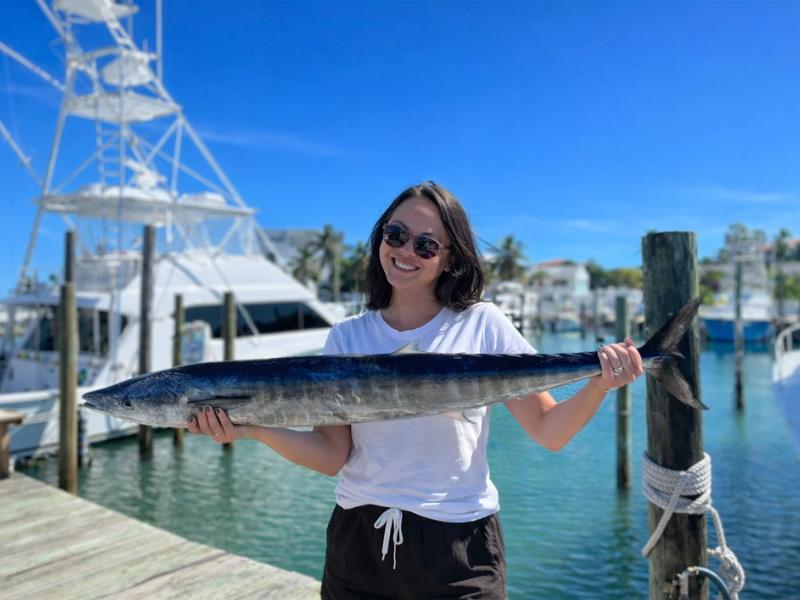
 Marine life is present year-round in TCI. Visibility peaks December through April during the dry season. Humpback whales are only present January through April. Turtle sightings are most reliable at the shore reefs year-round but peak during nesting season (April through August) on remote cays. Eagle rays are more consistently seen in specific areas with local knowledge. The outer reef sites at West Caicos and French Cay are best accessed in calm sea conditions, which are more reliable in winter.
There is no bad month for snorkeling or diving in TCI in terms of water temperature. The range across the year is 77 to 85 degrees Fahrenheit. What changes is visibility (better in the dry season), sea conditions (calmer in winter for the outer reef sites), and which specific animals are present. The humpback whale window is the only hard seasonal constraint. Outside that, everything else from turtles to sharks to rays is available year-round, with the quality of the encounter dependent more on which reef you’re visiting and the conditions on a given day than on the month.
February is the single best month if you want to maximize all options: excellent visibility, good sea conditions, peak humpback whale season, and the outer reef sites accessible in the calm winter swell pattern. November is the best month for value-conscious travelers who still want strong marine encounters: warm water, thin crowds, and every species still present except the whales.
Still deciding when to pull the trigger on booking? This guide on the best time to visit Turks and Caicos tours gives you a straight answer based on what most travelers actually prioritize.
How Do You Protect The Marine Environment When Snorkeling Or Diving?
 The DECR enforces strict rules inside all TCI national parks: no fishing, no collection of any marine life, no coral contact, no feeding of any animal, no anchoring on reef. For visitors: use reef-safe sunscreen (zinc oxide or titanium dioxide only), never touch marine animals, maintain neutral buoyancy, keep fins away from coral, and book with DECR-licensed operators. These rules are not suggestions. Violations carry significant fines.
The reef that makes TCI worth visiting is the same reef that requires active protection to remain what it is. Chemical sunscreens containing oxybenzone and octinoxate cause measurable coral bleaching and damage to polyps. This is not a remote environmental concern; it affects the reefs where visitors are snorkeling. Every reputable operator in TCI now requires reef-safe formulas, and several make it a condition of boarding the boat. Zinc oxide and titanium dioxide are the active ingredients to look for. Bring them from home; they’re available on island but more expensive.
Touching a sea turtle is illegal in TCI. Touching a coral is damaging to the polyp. Feeding a shark, ray, or any fish inside a national park is also illegal under DECR rules. These rules protect the marine environment from the cumulative impact of the million-plus visitors who pass through TCI waters annually. They also protect visitors: a nurse shark that’s been fed by tourists is a nurse shark with learned behavior around humans that can result in unexpected contact.
Booking with a DECR-licensed operator means the company has agreed to follow these standards. It’s the simplest filter for quality. Questions about responsible marine encounters or licensed operators in TCI? Compare current boat tours to the reef.
The visibility here is unlike most places in the Caribbean but not every tour takes you to the good stuff. Here’s the best snorkeling tours in Turks and Caicos so you spend your time above the right reef.
What Our 16,800 Travelers Say About Marine Life in Turks and Caicos
| Saw a sea turtle during their stay | 68% | Most sightings at Bight Reef and Smith’s Reef; higher on boat tours |
| Saw a spotted eagle ray | 54% | Most common at Smith’s Reef and on outer reef boat tours |
| Saw a shark (nurse or reef) during their visit | 47% | Higher rate on outer reef and West Caicos dive/snorkel tours |
| Saw a dolphin (including JoJo sightings) | 39% | Most common on boat tours along Leeward and Grace Bay coastline |
| Jan-Apr visitors who saw or heard humpback whales | 64% | In-water encounters on dedicated outer reef tours; sightings highest in Feb |
Frequently Asked Questions
Are there dangerous marine animals in Turks and Caicos?
Sharks and barracuda are present but pose no practical danger to snorkelers and divers who behave appropriately. There are only three recorded shark attacks in TCI history, none fatal. Lionfish, which have venomous spines, should not be touched. Jellyfish appear occasionally and cause minor welts. Fire coral causes a stinging rash on contact. The main guidance is simple: look with your eyes, not your hands.
Can you swim with turtles in Turks and Caicos?
Yes. Green turtles are commonly encountered at Bight Reef and Smith’s Reef directly off the beach on Providenciales. You can swim alongside them at a respectful distance. Touching turtles is illegal under TCI law. Boat snorkeling tours to the outer reef increase the likelihood of encounters with both green and hawksbill turtles.
Who is JoJo the dolphin?
JoJo is a wild Atlantic bottlenose dolphin who has freely interacted with swimmers and divers in Grace Bay since the early 1980s. He was declared a National Treasure by the Turks and Caicos government in 1989, the only such designation ever given to a marine animal in TCI. He is wild, protected by law, and cannot be touched. He chooses his own interactions and is often spotted on boat tours along the northern shore of Providenciales.
When can you see humpback whales in Turks and Caicos?
Late December through April. Peak viewing is January through mid-March. Salt Cay and Grand Turk offer the best conditions because the Turks Island Passage funnels whales close to shore. In-water encounters are possible on dedicated charter tours through operators like Big Blue Collective, though they are never guaranteed. February is statistically the best month for sightings.
We’ve been guiding travelers through TCI’s marine environment since 2012 and have a deep respect for the reef system that makes this destination what it is. Whether you want a reef snorkel for wildlife encounters or are planning around whale season, browse the boat tours.
Written by Baran Ellis
British tour guide since 2012 · Founder, Turks and Caicos Tours
Baran has guided over 16,800 travelers across Providenciales, Grand Turk, and the Caicos cays since founding the agency.